Comprehensive Guide to Business Tax Filing: Federal & New York State
Navigating business tax obligations requires managing requirements at both the federal level with the Internal Revenue Service (IRS) and the state level with the New York State Department of Taxation and Finance (DTF).
Because New York State imposes specific entity-level taxes, pass-through entity elections, and regional surcharges, aligning your federal return with your state filing strategy is essential to minimizing liability and ensuring compliance.
1. Federal & NYS Business Tax Forms by Entity Structure
Your legal entity type determines which income tax returns and supplemental filings you must submit annually:
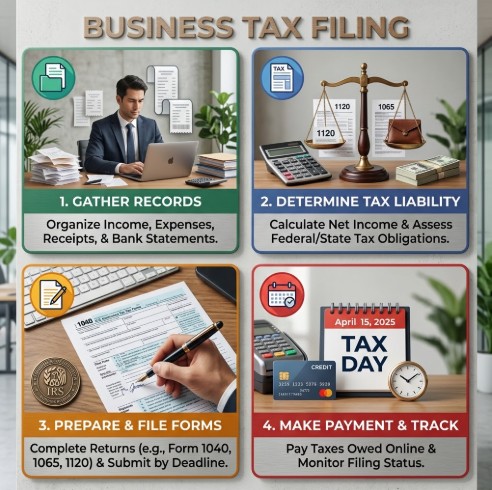
| Entity Type | Federal Return (IRS) | NY State Return (DTF) | Key State Filing Detail |
| Sole Proprietorship / Single-Member LLC | Form 1040 (Schedule C) | Form IT-201 (or IT-203) | Income passes directly through to your individual tax return. |
| Partnership / Multi-Member LLC | Form 1065 | Form IT-204 | Annual partnership filing; filing fees (Form IT-204-LL) may apply. |
| S-Corporation | Form 1120-S | Form CT-3-S | Must file Form CT-6 to elect S-Corp status in NY State separately from federal. |
| C-Corporation | Form 1120 | Form CT-3 | Subject to NY State Franchise Tax on business income or capital base. |
2. New York State Corporate Tax & Regional Surcharges
Corporations operating within New York face state-specific tax rates and location-based adjustments:
- NYS Corporate Franchise Tax: The general business corporate tax rate is 6.5% for standard income, with a 7.25% rate for tax bases exceeding $5 million.
- MTA Business Tax Surcharge: Businesses operating in the Metropolitan Commuter Transportation District (NYC, Long Island, and lower Hudson Valley) are subject to an additional 30% surcharge on the portion of state franchise tax apportioned to the region.
- New York City Taxes: C-Corporations operating in NYC face an additional New York City Business Corporation Tax with rates up to 8.85%. Pass-through entities in NYC may also be subject to the Unincorporated Business Tax (UBT).
3. NYS Pass-Through Entity Tax (PTET) Optimization
The New York State Pass-Through Entity Tax (PTET) is an optional entity-level income tax designed to help owners of Partnerships, LLCs, and S-Corporations work around the federal $10,000 State and Local Tax (SALT) deduction cap.
  ┌──────────────────────────────────────────────────────────────┐
  │  Elect NYS PTET (Annual Election Deadline: March 15)        │
  └──────────────────────────────┬───────────────────────────────┘
                                 │
                                 ▼
  ┌──────────────────────────────────────────────────────────────┐
  │ Entity pays state tax directly (deductible on federal 1065 / │
  │ 1120-S, reducing federal taxable income)                     │
  └──────────────────────────────┬───────────────────────────────┘
                                 │
                                 ▼
  ┌──────────────────────────────────────────────────────────────┐
  │ Owners claim a corresponding refundable credit on their      │
  │ individual NYS return (Form IT-201)                          │
  └──────────────────────────────────────────────────────────────┘
4. Employer Payroll & State-Level Surcharges
Businesses employing staff in New York must manage state payroll taxes in addition to federal FICA and FUTA obligations:
- NYS Unemployment Insurance (SUI): Employers must contribute to the state unemployment fund based on experience ratings and taxable wage bases.
- Metropolitan Commuter Transportation Mobility Tax (MCTMT): Employers within NYC and surrounding counties with quarterly payroll expenses exceeding statutory thresholds must pay an MCTMT surcharge ranging up to 0.60%.
- New York Paid Family Leave (PFL) & Disability (DBL): Mandatory coverage required for all full-time and qualifying part-time New York employees.
5. Critical Federal & State Deadlines
- March 15:
- Federal & NYS tax returns due for S-Corporations (Forms 1120-S / CT-3-S) and Partnerships (Forms 1065 / IT-204).
- Annual deadline to elect into the NYS PTET for the tax year.
- Form IT-204-LL filing fee deadline for LLCs and LLPs.
- April 15:
- Federal & NYS tax returns due for C-Corporations (Forms 1120 / CT-3) and Sole Proprietorships (Schedule C).
- First quarter estimated tax payments due for Federal and NYS.
- September 15: Extended deadline for Partnerships and S-Corporations filing formal extensions.
- October 15: Extended deadline for C-Corporations and Sole Proprietors filing formal extensions.